A Safeguarding Adult Review (SAR) is a statutory review arranged by Warrington Safeguarding Adults Board when an adult with care and support needs has died or experienced serious abuse or neglect, and there are concerns about how organisations worked together to safeguard them. SARs are required under section 44 of the Care Act 2014.
The purpose of a SAR is to identify learning and improve practice. It is not about blame, and it does not replace criminal investigations, complaints, disciplinary processes or regulatory action.
SARs help agencies understand what happened, what worked well, what could have been done differently, and what needs to change to reduce the risk of similar harm happening again. Learning may relate to areas such as information sharing, risk management, mental capacity, Making Safeguarding Personal, multi-agency working, recording, escalation and professional curiosity.
SAR in Rapid Time
A Safeguarding Adult Review in Rapid Time (SARiRT) is one method a Safeguarding Adults Board may use to gather learning more quickly. It is not a separate legal process, but a review approach that focuses on system learning and improvement. SARiRT usually produces a short, focused report that identifies practical learning for agencies and practitioners.
Involving people in reviews
Where appropriate, the adult, their family, carers or representatives should be offered the opportunity to contribute to the review. Their views should be treated sensitively and used to help understand the adult’s experience and what needs to improve.
Practitioners and agencies may also be asked to contribute information, attend learning events or help develop improvement actions. The focus should be on open, honest reflection and shared learning.
Learning and improvement
The Board uses learning from SARs to strengthen local safeguarding arrangements. This may lead to changes in policy, practice guidance, training, supervision, audit, quality assurance or partnership working. Progress against SAR actions is monitored by the Board and reported through the WSAB annual report.
Referring a case for SAR consideration
If you believe a case may meet the criteria for a Safeguarding Adult Review, you should follow the Warrington Safeguarding Adults Board SAR referral process. Referrals should explain what happened, which agencies were involved, why the SAR criteria may be met, and whether there are any immediate safeguarding concerns or parallel processes underway.
Key message
Safeguarding Adult Reviews are about learning, improving practice and strengthening partnership working so that adults with care and support needs are better protected from abuse and neglect.
SAR Referrals must be made to the Safeguarding Partnerships Team safeguardingpartnerships@warrington.gov.uk or by telephone 01925 444085. Once the referral has been made the Safeguarding Partnerships Team will support the referrer to complete the attached SAR Referral Form with enough information to inform the screening process.
Access the SAR Referral Form - click here
The Chair of the WSAB Safeguarding Adults Review and Learning (SARL) Group with support from the Safeguarding Partnerships Manager, will review all referrals prior to arranging the screening process.
At this stage, if the referral information does not suggest that the eligibility criteria would be met, following consultation with other statutory members the SARL Group Chair may reach an agreement not to screen the referral. Where this is agreed the referrer and the Independent Chair will be informed of the rationale for not screening the referral by the Safeguarding Partnerships Manager. If it is considered that there is a more appropriate route or process to which the case should be referred such as for a Safeguarding enquiry, or an investigation under a different framework, the referrer will be advised of this.
The full SAR Protocol can be accessed here.
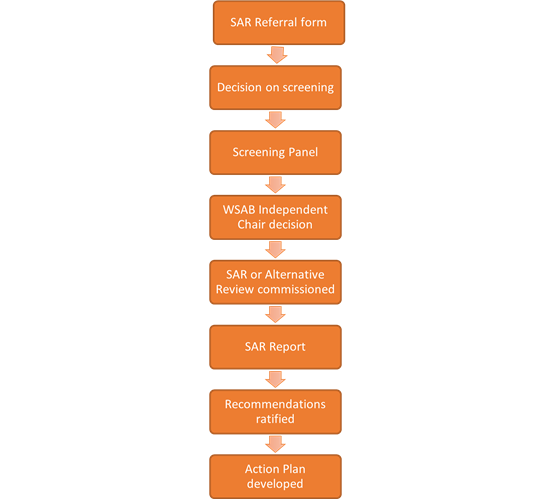
A summary of the process is described in the flowchart below.
Not found what you were looking for?
To view previously published SARs and Learning Briefs in Warrington click here
To access information available to friends, family and carers click here
To Access the National SAR Library click here
For further information on SARs please access the Social Care Institute for Excellence website